Showing posts with label economic growth. Show all posts

Tuesday, October 25, 2011

Chinese growth, the future of India et al.

China has shown some impressive growth numbers and has passed US this year as the biggest economy in the world. One key elements of China's impressive growth has been undervalued currency which has subsidized exports, investments and together with rising salaries consumption as well. Just look at the chart below (click to enlarge).


The growth components of the developed world is usually dominated by personal consumption which adds up to 80-90% of GDP growth. What happens if the salaries of Chinese workers have risen to a level that makes it financially reasonable to move your factories to India, Indonesia or Vietnam for example? What happens if there is no undervalued currency (due to pressure from inflation or other countries), no massive investments to export sector hence reducing pressure to raise wages as well (reducing consumption)?

One thing is for sure - this trend is good for India and other poor Asian and African countries. This might also be good for Western countries since more people in the world get richer creating jobs in Western countries as well. What kind of changes this means to China is uncertain.

Wednesday, September 28, 2011

Against EFSF? Really?

Estonia's parliament will vote on expanding the powers of EFSF tomorrow together with Germany. As always media and politics have managed to develop a circus out of the discussion preceeding the vote. Polls show that Estonian people are mostly against expanding EFSF (also those supporting our current right-liberal government). Some of the people shout out arguments like "Greece should go bankrupt" or "Why do we have to feed banks". This was followed by a statement from our centre (populist) opposition party that they also don't support joining the EFSF probably hoping to get some votes. Since people are getting very emotional on this subject I will lay out some most important facts about EFSF. (Check these out yourself HERE)

1) First and foremost - EFSF was created with an intention to preserve financial stability in the eurozone by providing temporary financial assistance to governments or banks in difficulty. In other words it is supposed to AVOID crises like we are in now.
2) EFSF finances itself by issuing bonds that are guaranteed by all 17 eurozone countries up to 440 billion euros. Countries participating in EFSF do not pay any additional funds to EFSF, it is backed by guarantees.
3) EFSF is only a temporary measure to handle the current crisis and its permanent follower will be ESM or European Stabilisation Mechanism.

Q: What happens if a country doesn't participate in the EFSF?
A: There's a risk that other countries don't want to particpate as well, who will finance the EFSF then?

Q: Why do we need EFSF at all?
A: To avoid uncontrolled bankruptcies of banks and countries

Q: Why do we need to avoid their bankruptcies if they have overspent?
A: Since if we don't borrowing costs for countries like Italy, Spain, France, Belgium etc will rise significantly leading to other bankruptcies. Banking system as we know it might fall because of the losses that these banks will have (the banks are holding the bonds that are worthless after a bankruptcy of a country). There will be no more euro.

Q: What happens if euro goes?
A: Countries like Germany, Estonia, Finland, Netherlands etc that are financially sound will get currencies that will rise significantly in value causing our exports to fall greatly (it is then more expensive for other countries to buy our products). This will bring massive unemployment and loss in economic welfare. It has been estimated that the effects of such an event would lead to 20-40% fall in GDP in first year. For countries like Spain, Italy and Greece this might even leed to civil war since their currency would devalue so greatly that the people of these countries are unable to pay off their loans. There would be massive unemployment since there is no funding for investments (who would borrow to a bankrupt country in civil war?). GDP of these countries could even fall 50% or more. (Analysis is done by UBS).

The total loss of these events will surpass trillions of euros (if you look at European GDP of about 12 trillion EUR). The countries going through tough austerity measures including budget cuts and reforms will hopefully turn to growth in a couple of years. It is not like regular people of these countries aren't suffering enough already. Hasn't Europe learned anything from its history just 70 years ago? It's not like we are not on the edge of a cliff..

Thursday, September 22, 2011

Operation Twist not impressive, fiscal stimulus needed

Fed announced yesterday that it would change the average maturity of its bond holdings towards longer term bonds. This is carried out by selling short term government bonds (2-3 years) and buying long term bonds (6-30 years). The idea of this operation is to lower long term yields thus making mortgages cheaper and stimulating economic growth through housing market. This isn't something that markets liked to hear, unfortunately. S&P500 was down more than 2% yesterday in addition to -3% already at pixel time. Not to mention DAX that is down more than 5% in trading today.


There has been a lot of talk of decreasing effect of more quantitative easing. Since yields are on record lows already the effect of manipulations performed by Fed have just marginal effect. The problem is not that long term yields are too high. Interest rates are near 0% already. The problem is economic outlook. Companies aren't investing as much as they used to hence not supporting employment, the future of individual persons is everything but certain. There's only so much that Fed can do about it. They have done everything they can.

Unfortunately Fed is one of few institutions that realizes the importance of financial markets in modern economy and their importance in supporting economic growth. Unfortunately Fed is also one of few institutions that is willing to act quick. What is needed today, is economic stimulus by fiscal expansion.

We need governments of the biggest countries to step in, initiate infrastructure projects thus directly subsidising employment. We need them to expand not contract. Even though we have a debt crisis in our hands we need to borrow (and grow) are way out of this mess. Governments tend to overspend during good times and underspend during bad times. This is not the fiscal policy we signed up for! That's the basic idea of fiscal policy - to level out economic cycles.

Debt crisis has to be handled by bold guarantees by central banks (for example unlimited purchase of government bonds) or by issuance of eurobonds for example (in the eurozone). Instead of this we are crossing our fingers and hoping that we will somehow get out of this mess, dealing with consequences.

Unfortunately things have to get really tough for this to happen. Stocks are cheap around the world. We need bold action by governments to get the stocks rising again. Watch out for these weekend meetings of countries. I wouldn't want to be short ahead of some bold plans when these would be announced at some point.

Thursday, August 18, 2011

Another recession coming up in Europe?

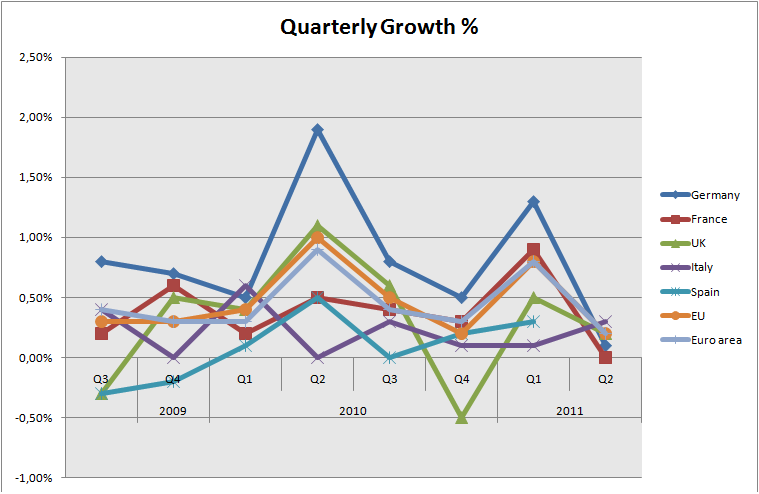
There has been a lot of talk about another possible recession that the world could face. Focus on debt and spending isn't helping since government spending also contributes to economic growth. Following chart presents real economic growth (adjusted with inflation) on a quarterly basis (compared with previous quarter) in the biggest economies in Europe (also for comparison purposes EU27 and eurozone countries in average)


As can be seen from the chart the sudden slowdown occured in the second quarter of current year in all countries at the same time which is remarkable. It can also be seen that sudden slowdown occured again in the final quarter of 2010. The effects of the previous slowdown was thought to be related with extreme weather conditions in northern Europe. This shows that small things (or extraordinary) can have a big effect on economic growth - considering that it is already fragile due to the recent (and still ongoing) financial crisis.

The following chart presents real economic growth on an annual basis (GDP value of current quarter vs GDP value of the same quarter last year - this methodology is not used by major statistics departments which calculate annual growth by multiplying current quarter growth by 4).


From this chart it can be seen that growth indeed has slowed considerably but there is no reason for panic. Previous recession was followed by a quick recovery and the growth has slowed. Whether we will go into negative territory we will find out in October-November.

Couple of more things have to be taken into account. Second quarter numbers obviously include the effects of Japanese nuclear disaster in March and since the whole supply line of major industries was disrupted some of the growth might have just gone there. Also European Central Bank has risen interest rates already twice this year which definitely has a negative effect as well. Cutting of budget deficits isn't helping.

We might see a bounce in economic numbers if some of the weak growth was caused indeed by the Japanese disaster. We might also see ECB lowering rates if weak growth continues and in addition to that some additional measures by the Bank of England (monetary stimulus). All in all I am pretty confident that we will not see a bad recession coming just now.